
Salesforce: Asia's AI Shift from Pilots to Production

Alexander Bazilevich is a CRM expert and Top Salesforce Partner with over 17 years of sales experience in the IT industry. He specializes in transforming corporate goals into profits through cross-functional collaboration and innovative business solutions, with deep expertise in business systems and IT products.

Salesforce's Great Asia AI Summit 2026: From pilots to production, focusing on trust, governance, and scaling generative AI.
At the Great Asia AI Summit 2026, Salesforce highlighted Asia's AI shift from pilots to production, a key focus for over 4,000 virtual attendees. The summit, held on February 13, addressed the critical challenge for regional enterprises: scaling generative AI from experiments into industrial-grade systems for marketing, sales, and service.
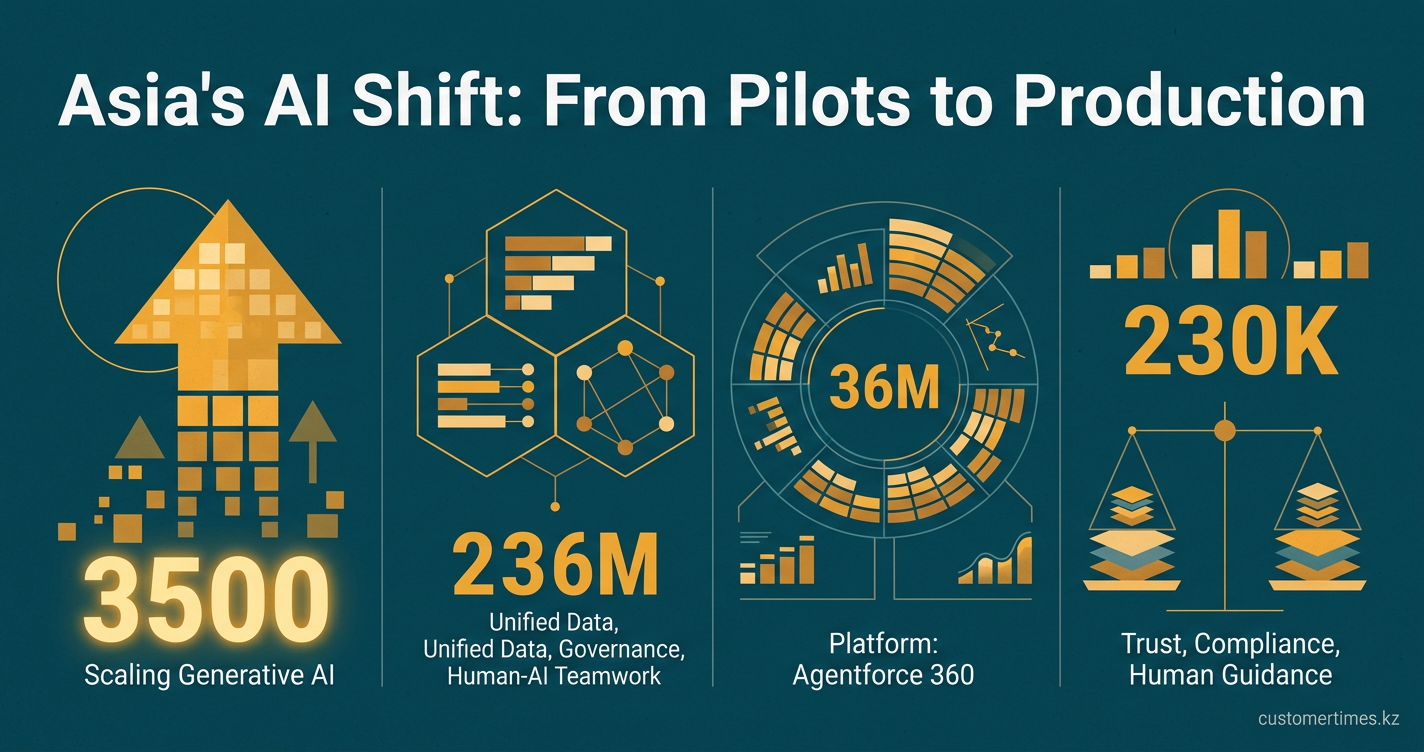
The summit showcased how platforms like Salesforce's Agentforce 360 enable businesses to integrate data, AI, and human oversight securely. Success stories from Singlife, which accelerated claims processing, and Tata Power, which improved equipment maintenance, demonstrated tangible results. Experts emphasized that building trust, ensuring compliance, and maintaining human guidance are now paramount for successful AI adoption, outweighing purely financial metrics.
How are enterprises in Asia moving generative AI from pilots to production at scale?
Asian enterprises are scaling generative AI by unifying customer data for secure access, implementing strong governance for AI agents with clear audit trails, and redesigning business operations for seamless human-AI teamwork. This strategy places a high premium on trust, security, and regulatory compliance throughout the process.
Enterprises across Asia are transitioning generative AI from pilot phases to full-scale production by implementing three strategic shifts. These include creating unified and permissioned customer data frameworks, establishing robust AI agent governance with comprehensive audit trails, and redesigning operations to foster effective human-AI collaboration while prioritizing trust and security.
"South Asia sits at a unique inflection point - where scale, digital ambition, and a strong talent base converge... Trust, governance, and human oversight will define who scales responsibly."
- Arundhati Bhattacharya, President & CEO, Salesforce South Asia
Agentforce 360 becomes the North-star architecture
Discussions across all industry tracks - from banking and telecom to consumer goods - centered on Agentforce 360, Salesforce's comprehensive platform for building, governing, and monitoring autonomous AI agents. This platform integrates key components to move beyond standalone copilots:
- Data Cloud: Provides zero-copy access to ERP, HR, and external data signals.
- Einstein 1: The reasoning engine that determines the appropriate tool for a given task.
- MuleSoft: Enables API-level actions within legacy systems.
- Slack: Serves as the interface for human-in-the-loop oversight.
Early adopters reported significant results. Singlife deployed claims-settlement agents that reduced average resolution time from 3.5 days to just 18 minutes. Meanwhile, India's Tata Power used field-service agents to preemptively schedule maintenance, preventing 22% of transformer faults.
From pilots to production - three tipping points
A live summit poll revealed that while 71% of attendees have at least one generative AI proof-of-concept, only 18% have scaled it beyond departmental use. Experts identified three sequential shifts required to bridge this gap:
| Shift | Capability Gate | Typical Road-block |
|---|---|---|
| 1. Data readiness | Unified, permissioned customer graph | Fragmented data lakes, PII residency rules |
| 2. Agent governance | Policy layer for autonomy limits | No model inventory or audit trail |
| 3. Ops re-wire | Human-AI collaboration workflows | Change fatigue, misaligned KPIs |
Jayant Dabholkar, Chief Digital & IT Officer at Tata Power, cautioned against overlooking governance: "Agents that optimise SLAs can inadvertently breach load-balancing protocols if safety guardrails live only in code."
Regional heat-map: India volume, ASEAN velocity
India dominated regional AI usage, registering 82.3 billion enterprise AI/ML API calls in the latter half of 2025 - representing 46% of all Asia-Pacific traffic. This growth was led by the technology, manufacturing, and banking sectors. While Southeast Asia has lower transaction volumes, it leads in adoption speed: 46% of ASEAN firms have scaled AI beyond the pilot stage, compared to a global average of 35%.
| Metric | India | Six-key ASEAN markets |
|---|---|---|
| AI transactions (Jun-Dec 2025) | 82.3 B | 19.4 B |
| Companies past pilot stage | 31% | 46% |
| Top adoption sector | Tech & comms (31.3 B) | Financial services |
| 2026 focus | Sovereign cloud + GCC R&D | Localised agents (Tagalog, Thai, Vietnamese, Bahasa) |
Sovereign AI infrastructure is proving to be a key enabler. New data zones, such as Singapore's Saab-compliant cloud region and Indonesia's in-country data centers, are accelerating AI adoption among banks requiring on-shore data storage.
Security and trust outrank ROI in CIO scorecards
A private C-suite session revealed a significant trend: when ranking success criteria for 2026 AI investments, 62% of executives placed "compliance & reputational risk" above "revenue lift." This reflects a decline in customer trust in AI, which, according to a Salesforce survey, fell from 58% in 2023 to 42%.
"Enterprise agents are moving AI from experimentation to execution... grounded in trust, governance, and human oversight."
- Siew Chiun Tan, Head of Platforms & Digital UX, Singlife
Industry leaders are actively sharing best practices on model cards, red-teaming exercises, and implementing "kill switches" for real-time agent control. Professor Michael Wooldridge of Oxford University emphasized the need for clear boundaries, stating, "An agent that negotiates a loan restructuring cannot also explain Basel III capital ratios - boundary setting is everything."
Skills pipeline and the 1,950 GCC effect
India's Global Capability Centres (GCCs) are evolving into major AI R&D hubs. Firms like Salesforce, SAP, and AWS are projected to hire 180,000 new engineers in 2026. At the summit, a joint Agentforce certification with NASSCOM was announced, aiming to reskill 25,000 consultants by early 2027. In ASEAN, polytechnics in Singapore and Thailand will integrate agent-builder modules into their curricula starting in September.
Real-world roll-outs to watch
Key examples of this AI transition in action include:
- Vietnam's Techcombank: Launching next-best-offer agents in June for its 8 million retail customers.
- Philippines' Globe Telecom: Integrating network-troubleshooting agents with technician Slack channels, reducing truck rolls by 12%.
- Indonesia's Bank Mandiri: Using credit-decision agents to cut retail loan approval times from 3 days to 15 minutes, while maintaining data sovereignty in Jakarta.
Competitive lens - why CRM becomes the AI battlefield
Salesforce's leadership claim as the #1 AI CRM is backed by compelling data. The firm's 2026 State of Sales Report reveals that 83% of sales organizations using AI agents saw revenue growth, compared to just 66% of non-AI teams. Internally, Salesforce agents converted 3,200 dormant leads from a pool of 130,000 in four months - a result unattainable with traditional tools.
Competitors are rapidly advancing, with Microsoft's Dynamics 365 Copilot, HubSpot's Content Agent, and Adobe's Journey Optimizer all adding agentic capabilities. However, Salesforce asserts its key differentiator is its deep integration with 25 years of CRM metadata and a library of over 200 pre-built actions for Agentforce.
Looking ahead - event resources
For teams looking to benchmark their progress, session recordings, presentations, and the new AI Maturity Benchmark tool are available on the GAAIS 2026 replay hub. Completing the benchmark provides a personalized readiness report that compares a firm's data, governance, and skills against industry peers.