
Kazakhstan's IT outsourcing transforms: AI boosts high-tech projects, pay

Kazakhstan's IT outsourcing transforms: AI boosts ticket prices 22%, cuts headcount 8%. Focus shifts to high-value AI services & talent.
Kazakhstan's IT outsourcing transforms as AI boosts high-tech projects, pay, and demand for specialized senior talent. A February 2026 debate on Fintech Time crystallised the industry's central question: will generative models and low-code platforms make the classic 'extended team' model obsolete? The market is indeed changing rapidly due to AI, but it is not disappearing. Instead, clients now seek smaller, expert teams for complex AI tasks, moving beyond basic coding. Thanks to significant investments in AI infrastructure and training, Kazakhstan is becoming a top spot for high-tech projects, marked by higher contract values and more advanced work. New roles like prompt engineers are in high demand as local companies begin exporting their AI products globally. The future lies in smart, skilled teams and secure, responsible technology.
Will AI and automation make traditional IT outsourcing obsolete in Kazakhstan?
AI is not making IT outsourcing in Kazakhstan obsolete but rather reshaping it. Automation is handling low-complexity work, which drives demand for smaller, more senior teams specializing in model tuning, AI compliance, and prompt engineering. This shift is leading to higher average contract values and more complex projects.
Yevgenia Lugina, engineering director at a major Kazakh service provider, stated emphatically that AI will not eliminate outsourcing. She clarified, however, that it is changing the game:
"AI does not remove outsourcing; it filters out low-complexity contracts and forces vendors to sell brains, not benches."
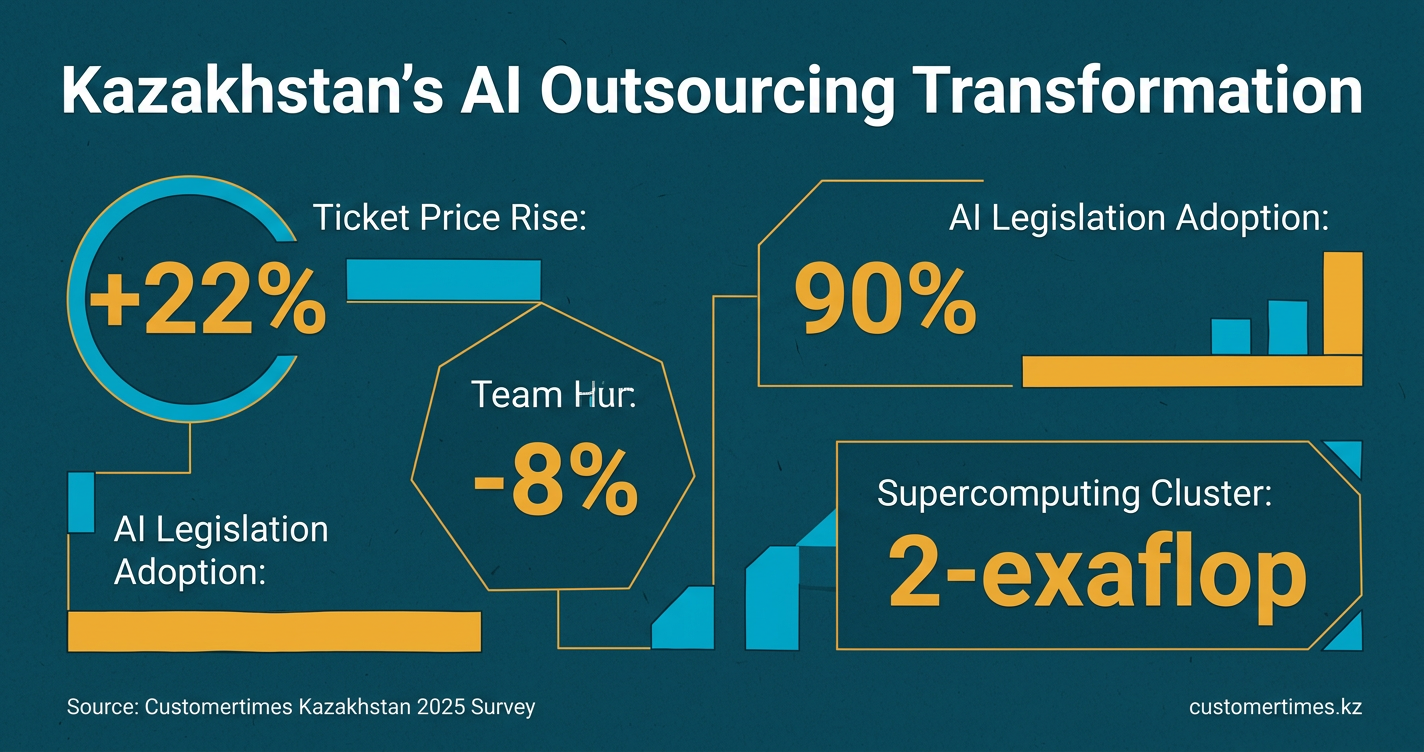
Early data supports this. A 2025 industry survey seen by Customertimes Kazakhstan revealed that pilot projects using AI-powered tools saw average ticket prices rise by 22% even as team head-counts fell by 8%. Clients are now paying a premium for smaller, senior-heavy squads that can fine-tune foundation models, secure data pipelines, and manage AI-generated outputs.
Why the Kazakh market is ripe for the "augmented" model
Artificial intelligence is not eliminating traditional IT outsourcing in Kazakhstan but rather transforming it. The focus is shifting from large-scale coding teams to smaller, highly specialized squads capable of managing complex AI systems, compliance, and model optimization, thus increasing the value and sophistication of outsourced projects.
Kazakhstan's state programme, 2026: Year of Digitalisation and Artificial Intelligence, is rapidly turning the country into a prime location for AI development. A new 2-exaflop supercomputing cluster, a data-centre valley near Astana, and 90% adoption of AI-specific legislation provide local outsourcers with infrastructure comparable to Prague or Warsaw but at the competitive price points of mid-tier Indian markets.
| Advantage | 2024 baseline | 2026 target | Impact on outsourcing mix |
|---|---|---|---|
| National AI-ready laws | 0% | 90% | Compliance projects instead of body-shopping |
| Super-compute capacity | 0.2 exaflops | 2.0 exaflops | Model-training & analytics work stays in-country |
| 5G coverage | 3 cities | Top-20 cities | Edge-AI, IoT support contracts emerge |
| AI-trained citizens | 120k | 1 million by 2030 | Talent pool for higher-end deliverables |
This state-led investment explains why global consultancies are establishing delivery centers, not just sales offices, in Almaty. They are pursuing high-value contracts that combine standard services like cloud migration with advanced offerings, such as fine-tuning Kazakh-language LLMs for banks or developing computer-vision quality control for the mining industry.
Hiring: from "how many?" to "how synthetic?"
The hiring landscape is shifting dramatically. Lugina notes that 40% of her firm's 2026 hires will be for roles like prompt engineers, vector-DB administrators, and reinforcement-learning testers - positions that had no presence on job boards just three years prior.
Local universities are adapting with remarkable speed:
- Nazarbayev University's Institute of Smart Systems offers a GPU hours for credits program.
- Tomorrow Schools of AI aims to teach 450,000 teenagers basic prompt engineering by December.
- AI University's first bachelor's cohort, starting in September, is already fully booked for corporate capstone projects with major telecom operators.
Despite these efforts, the talent pipeline is uneven, with a surplus of junior prompt engineers but a shortage of senior MLOps architects. This creates a lucrative opportunity for experts. A seasoned team lead who can manage a Stable-Diffusion farm and ensure compliance with Kazakhstan's new Law 230-VIII can bill at $110 per hour, triple the rate for a senior Java developer in 2023.
Project anatomy is changing
The structure of project engagements is also evolving. Traditional Statements of Work (SOWs) based on user stories are being replaced by AI-augmented SOWs that include model cards, data-provenance exhibits, and responsible-AI audit trails. Project timelines now incorporate dedicated red-team hallucination weeks, where clients attempt to "jailbreak" the AI system before final approval.
This new focus on safety has tangible value. A Shymkent-based FMCG distributor recently allocated 18% of its total contract value to these AI safeguards. The investment paid off: the company's churn prediction model increased its accuracy from 78% to 94%, generating an additional $3.8 million in annual margin - far exceeding the project's entire cost.
Domestic clients turn exporters
The Astana Hub's zero corporate income tax policy (valid until 2028) allows locally developed AI products to compete effectively on the global stage. A prime example from 2025 is a Telegram-based AI agronomist, which began as a small pilot for 200 local farmers and is now white-labelled for clients in Uzbekistan and southern Russia. This hybrid export model, featuring a core development team in Kazakhstan and near-shore support, is projected to boost service exports by $220 million by 2028, doubling the 2024 figure.
Risk ledger: compute access, metrics and vendor lock-in
Despite the rapid growth, several risks remain. Access to government supercomputing resources is rationed, and private GPU cloud services can cost 4 - 5 times more than in the US, potentially inflating budgets for on-shore model training by 35%. Furthermore, public-sector KPIs often prioritize the number of services launched over the quality of models governed, risking the creation of underfunded 'prestige projects.' Finally, local providers worry about regulatory overreach, as the new AI Law's risk classifications could place a simple diagnostic chatbot in the same high-risk category as an autonomous vehicle, tripling compliance costs.
What buyers should ask in 2026 RFPs
- Show your responsible-AI board minutes and red-team logs.
- Provide a GPU-hour escrow plan in case state cluster allocation is lost.
- Disclose your sub-contractor share; many local firms quietly outsource data labelling, creating potential data-sovereignty issues.
- Bundle knowledge transfer: insist on Kazakh-language documentation and on-premise model weights to mitigate geopolitical risks.
Bottom line for CXOs
For business leaders, the message is clear: Kazakhstan's outsourcing market is not shrinking but advancing to a higher tier of service. Expect to engage with smaller, more expensive teams delivering higher-impact results that include neural network artifacts alongside source code. Vendors who successfully adopt this new model, hire for AI-specific skills, and navigate the complex regulatory landscape will thrive. Those who continue to compete solely on hourly rates may find themselves left behind.