
Kazakhstan's AI-Powered Public Services: 93% Citizen Engagement

Alexander Bazilevich is a CRM expert and Top Salesforce Partner with over 17 years of sales experience in the IT industry. He specializes in transforming corporate goals into profits through cross-functional collaboration and innovative business solutions, with deep expertise in business systems and IT products.

Kazakhstan transforms public services with AI, aiming for 50% proactive services by December, boosted by new tech & DCO ambition.
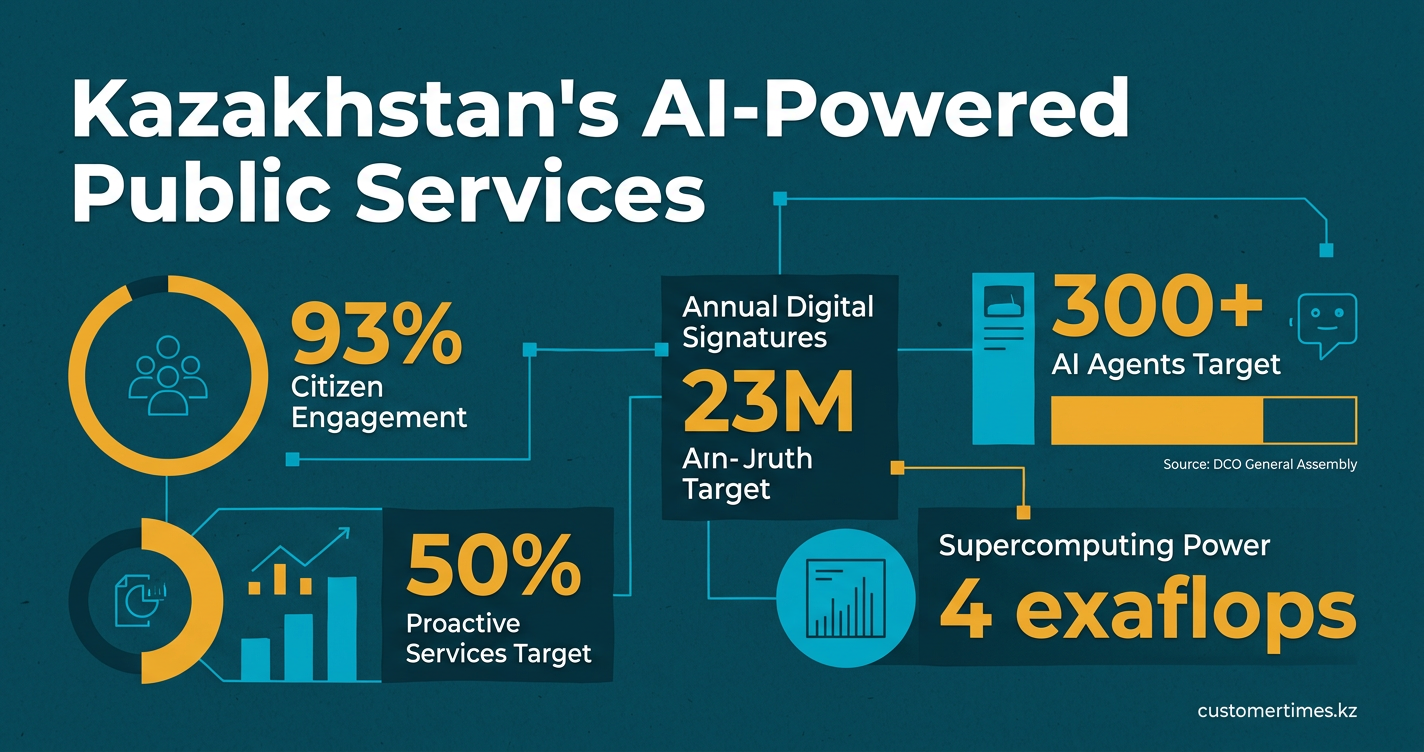
A testament to Kazakhstan's AI-powered public services, 93% citizen engagement is now achieved via the eGov.kz portal. During the 5th Digital Cooperation Organization (DCO) General Assembly in Kuwait, the nation detailed its comprehensive program to become a leader in platform-first, AI-driven governance. Key metrics include 23 million annual QR-based digital signatures and over 100 AI agents delivering proactive government services. The country aims for 50% of all public services to be proactive by 2026, eliminating the need for citizen applications in many cases.
How is Kazakhstan transforming its public services with digital and AI initiatives?
Kazakhstan is embedding artificial intelligence across public services through its Digital Qazaqstan strategy. This national initiative centralizes over 300 projects on the QazTech platform, leveraging AI agents and supercomputing power to deliver proactive services, from flood forecasting to automated business licensing, streamlining citizen-state interactions.
"Our task is to build a sustainable, unified and efficient state digital platform, where digital solutions function as a system rather than as fragmented projects," Deputy Prime Minister Zhaslan Madiyev told the audience, echoing a moratorium that since 1 January 2026 blocks any ministry from launching stand-alone information systems outside QazTech.
The centerpiece of this transformation is the Digital Qazaqstan strategy, which consolidates 300 sectoral projects into national initiatives that embed AI across ten key fields. The strategy's ambitious infrastructure growth is outlined below:
| Metric | 2023 | 2025 | 2026 target |
|---|---|---|---|
| Super-computing peak (FP8) | 0.3 exaflops | 2 exaflops | 4 exaflops |
| AI agents on eGov | pilot | 100+ | 300+ |
| Share of proactive services | 5% | 20% | 50% |
| Data-center tier III uptime | - | 99.982% | 99.995% |
This digital infrastructure is powered by a new NVIDIA H200-powered cluster, sovereign language models (KazLLM/AlemLLM), and a $200 million Amazon Kuiper-satellite deal to manage increased data traffic from an expanding 5G network.
These advancements deliver tangible benefits. The Tasqyn platform analyzes real-time satellite and weather data to send flood alerts to 1.8 million rural residents. On the KEDEN customs platform, machine-learning models have accelerated declaration clearances by 30%. The paperless e-Licensing "Green Corridor" has already issued 4,700 investor permits in just eight months.
President Kassym-Jomart Tokayev has labelled 2026 the "Year of Digitalization and Artificial Intelligence," telling parliament that digital competitiveness is "no longer a luxury, it is a survival imperative."
This national focus is earning international recognition. Kazakhstan ranks 24th in the 2024 UN E-Government Development Index and 10th for online service breadth. Meanwhile, Astana Hub, the national tech park, hosts 2,000 companies that exported $1 billion in IT services in 2025, a 42% year-over-year increase.
Seeking to expand its digital footprint, Kazakhstan presented several ready-to-launch joint projects to the DCO:
- Cross-border e-invoicing based on Kazakhstan's blockchain-backed E-Invoice system
- A DCO-wide AI sandbox using Al-Farabium supercomputer cycles for start-ups from member states
- Joint cybersecurity drills run through the Kazakhstan Cyber Shield simulation centre
Private-sector partners and educational programs are building a supportive ecosystem. The state-funded AI-Sana program aims to teach 650,000 pupils AI fundamentals by 2027, while universities are integrating industry-specific AI modules.
With the 2026 chairmanship of the Eurasian Economic Union on the horizon, Kazakhstan is positioned to champion a unified AI regulatory framework. As officials work toward concrete 2026 targets - including 50% proactive services and a second 4 exaflop supercomputer - the nation's digital leap is well underway.