
Kazakhstan: AI Transforms Public Sector, Boosts Economy

Alexander Bazilevich is a CRM expert and Top Salesforce Partner with over 17 years of sales experience in the IT industry. He specializes in transforming corporate goals into profits through cross-functional collaboration and innovative business solutions, with deep expertise in business systems and IT products.
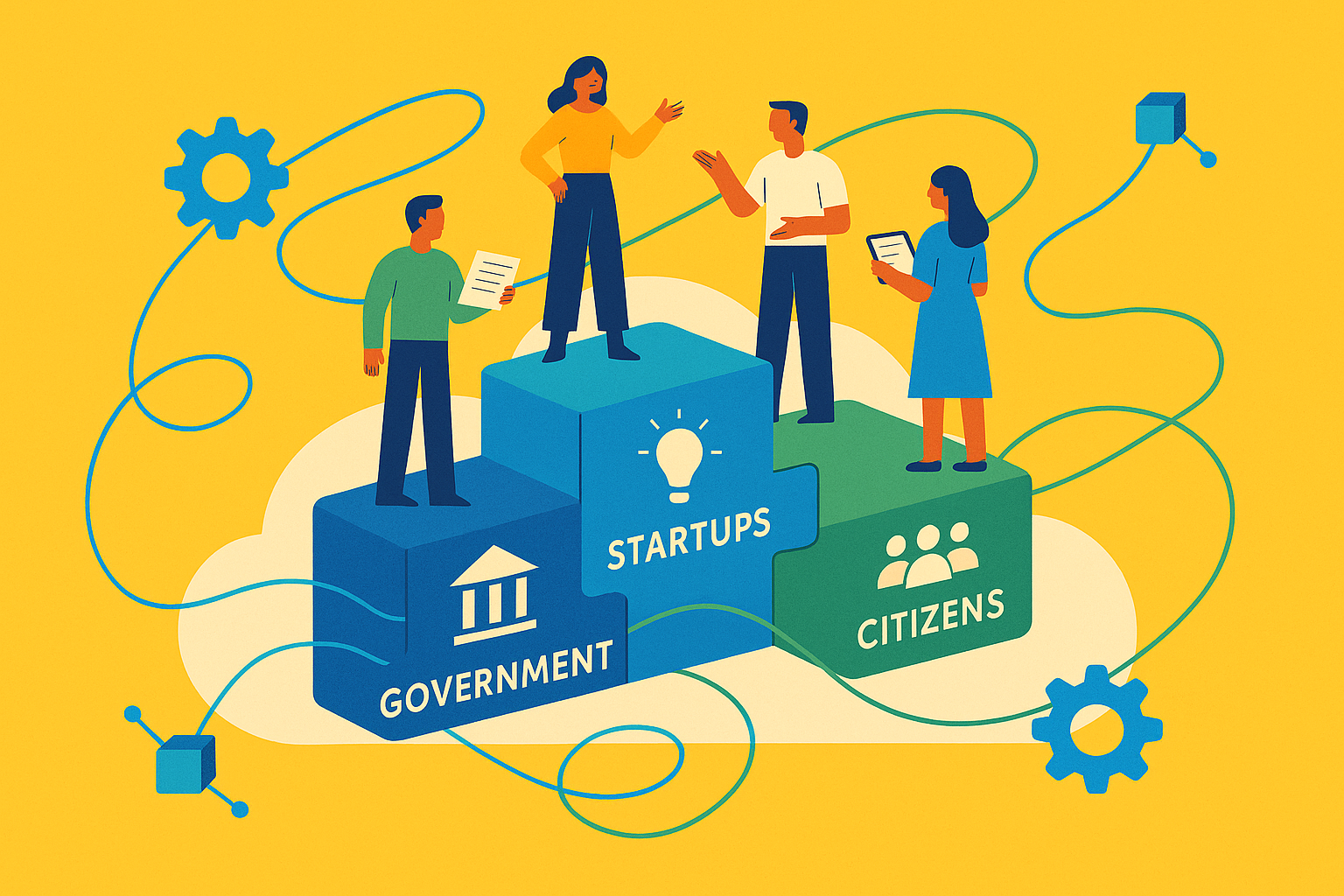
Kazakhstan's AI platform transforms public services, reducing red tape, boosting efficiency, and fostering a digital economy.
Kazakhstan: AI Transforms Public Sector, Boosts Economy
In a digital leap for Central Asia, Kazakhstan's AI transformation is revolutionizing its public sector and boosting the economy. By leveraging a powerful supercomputer and bespoke AI models, the nation is slashing bureaucratic red tape, dramatically improving government services, and fostering a vibrant tech ecosystem.
This national strategy is yielding tangible results: tax refunds are processed faster, healthcare is more efficient, and license renewals that once took days are now completed in hours. The government is also investing heavily in AI education and partnering with global tech leaders to expand digital infrastructure. As a result, Kazakhstan is saving a lot of money, making its cities smarter, and helping new tech businesses grow.
How is Kazakhstan using AI to transform its public sector?
Kazakhstan is deploying a national AI platform powered by a supercomputer to automate government services. This initiative uses sovereign large-language models and blockchain to reduce document processing times, cut citizen complaints, secure records, and drive significant economic savings and productivity gains across multiple ministries.
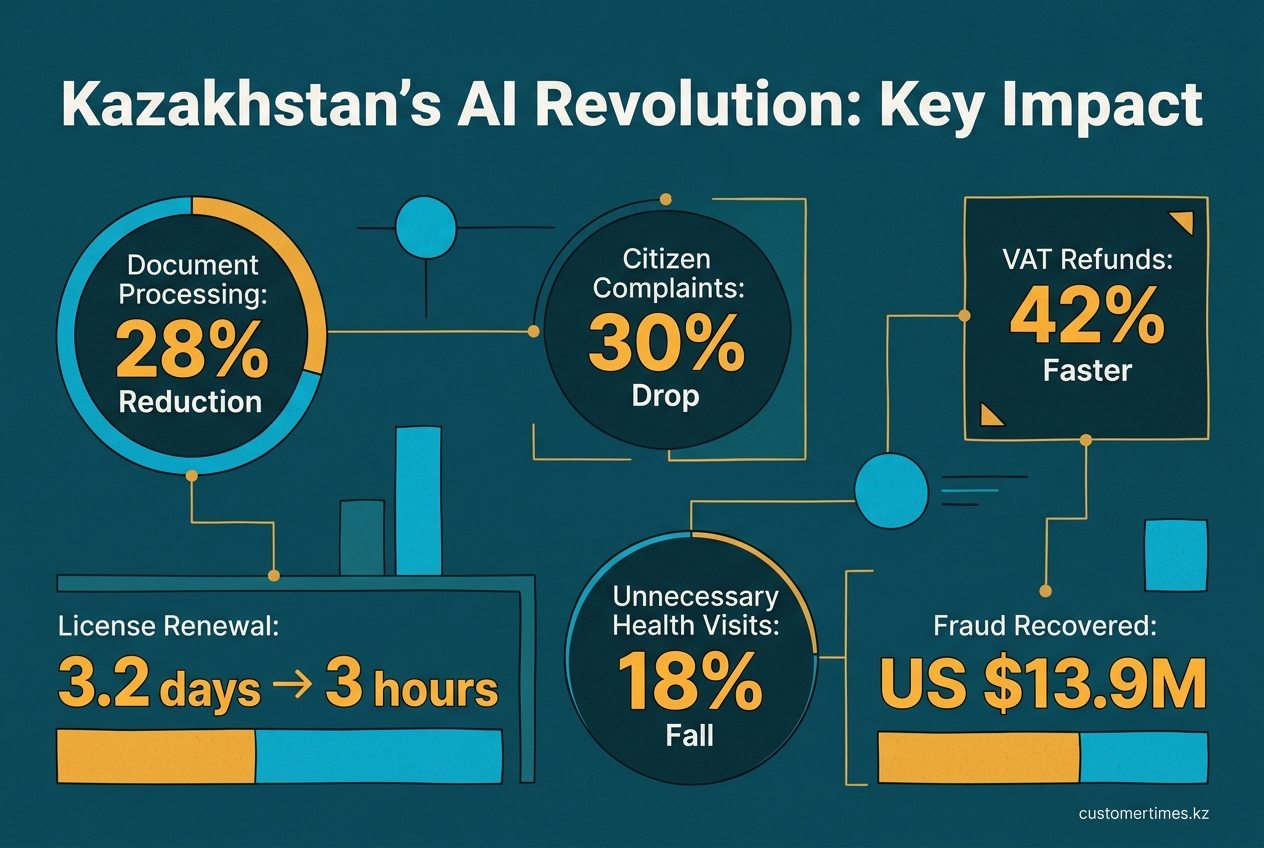
By December 2025, the new National AI Platform - a cloud environment built around a 2-exaflop supercomputer with 512 NVIDIA H200 GPUs - is set to manage live services for fifteen ministries. Initial results show a 28% reduction in document-processing time and a 30% drop in citizen complaints about red tape, surpassing the 2027 target for administrative reform.
The platform features a hybrid architecture:
- Two sovereign large-language models, KazLLM and AlemLLM, operate within a secure government enclave.
- Ministries access everyday services via QazTech, a low-code layer providing pre-built modules for identity, payments, and blockchain verification.
- A second GPU cluster is being built to maintain latency below 200 ms as the country moves toward its goal of making 80% of public services fully digital by 2027.
| Ministry | AI module now live | Measured gain (first 90 days) |
|---|---|---|
| Revenue | Tax Helper | 42% faster VAT refunds |
| Health | AI Therapist | 18% fall in unnecessary visits |
| Justice | QQazaq Law | 55% cut in search time for precedents |
| Transport | eGov AI | 3.2 days → 3 hours for licence renewal |
"We no longer ask citizens to bring paper proofs; the system talks to itself across ledgers secured by blockchain anchors."
- Minister for Artificial Intelligence and Digital Development, November 2025
A parallel blockchain mesh secures document integrity by recording the hash of every file, making retroactive tampering prohibitively expensive. A pilot for electronic sick-leave certificates has already recovered 7.5 billion tenge (US $13.9 million) from the shadow economy, a model now being applied to land registry and pharmaceutical imports.
Kazakhstan is also investing heavily in human capital. Over 440,000 secondary-school students have passed the optional AI-Sana exam. The class of 2026 will graduate with Python and ethics micro-degrees endorsed by the new AI Research University in Astana. The state aims to have five million citizens proficient in using AI models by 2029.
Strategic private partnerships are integral to this success. Oracle is establishing a Competency Center to train 3,000 civil engineers, while Beeline Kazakhstan and Starlink will deliver Direct-to-Cell satellite internet to 3,200 villages. Local tech integrators, many from the Astana Hub startup park, saw their government contract revenue double to US $240 million in 2025.
"Astana's traffic lights now run on reinforcement learning; peak-hour queues shrank 17% before any new road was built."
- Smart-City dashboard, December 2025 rollout
The economic impact is significant. The Digital Government Office reports 51.3 billion tenge (US $95 million) in combined savings and productivity gains, which are reinvested into AI-focused venture funds. In Q3 2025, Kazakhstan's IT-services trade balance achieved a surplus for the first time as foreign companies began using its KazLLM APIs.
Next on the roadmap:
- EnergyTech AI, a predictive maintenance tool for the power grid, is projected to save 42 billion tenge annually upon its 2026-27 nationwide rollout.
- The national messenger, Aitu, will integrate a digital wallet for seamless payment of taxes and fines.
- A Solana Economic Zone will allow global crypto firms to use Kazakhstan's 70%-renewable grid, with AI managing the energy load in real time.
With 92% of public services already online, Kazakhstan is transforming a national efficiency drive into a thriving platform economy that integrates government data, local startups, and foreign investment.